


Cost management involves controlling, analyzing, and reducing the costs involved in producing goods and services. This activity allows companies to operate more efficiently, increase profitability, and, above all, remain competitive in the market.
However, simply identifying and classifying these costs is not enough. You need effective control strategies to maximize profitability and reduce waste without affecting the quality of the product or service offered.
In this article, we cover the importance of cost management, list applicable methodologies, and explain how to reduce costs without compromising quality, in addition to presenting the main performance indicators for effective control and the crucial role of the ERP in this process.
What is cost management and why is it essential for companies?
Cost management is the process of planning, controlling, and analyzing the costs involved in producing goods or services. Its main goal is to ensure the company's financial resources are used as efficiently as possible, without waste and with a focus on maximizing profit.
This activity is essential to maintain financial sustainability and improve a company's competitiveness. It contributes directly to improving profitability and helps with strategic decision-making.
When costs are well controlled, it is possible to increase the company's competitiveness, improve the quality of the products or services offered, optimize resource allocation, and even reduce prices without negatively affecting profit margins.
In addition, effective cost management helps predict and manage financial risks, keeping the company better prepared to face crises or moments of economic instability.
Let's take a closer look at these benefits of cost management.
Improved profitability
Cost management makes it possible to identify where resources are allocated and analyze whether they are used in the most efficient way. With strict control, a company can increase its profit margins, reduce unnecessary expenses, and adjust prices more strategically.
Profitability improves by lowering operating costs without impacting the quality of the products or services offered. This control also helps prevent the company from spending more than necessary on items that do not directly add value to the business.
Resource optimization
When costs are constantly monitored, the company can identify resources that are underused or even wasted. This can include labor, materials, energy, and time.
By reducing idle time on a production line or optimizing raw material usage, for example, the company can save considerably and improve productivity without compromising quality.
Resource optimization not only helps reduce costs but also increases operational efficiency. This allows the company to focus on more profitable activities.
Data-driven decision-making
With cost management, the company has access to clear, accurate data about its spending behavior. This information is essential for formulating strategies, as it supports more assertive business decisions.
If cost analysis shows that certain products or services consume more resources than others, the company can take steps to optimize those processes or even discontinue less profitable products.
In addition, good cost management makes it possible to identify spending trends and patterns, which makes long-term financial planning easier.
Waste reduction
Identifying waste involves analyzing the entire production process, from the purchase of raw materials to the delivery of the final product. The goal is to detect areas where resources are being misused.
A failure in inventory control can lead to over-purchasing, with idle, unnecessary material. This directly impacts the company's working capital.
Cost management helps identify this waste and implement improvements. That way, resources can be used as productively as possible, without compromising final product quality.
Increased competitiveness
A company with cost control has more flexibility to adjust its prices competitively without hurting its profit margin. With effective cost control, the company can lower prices to offer customers better conditions without harming profitability.
Better competitiveness is not limited to price — it also extends to the quality of the service or product offered. Companies that know how to manage their costs are better able to innovate, improve their products, and thus capture a larger share of the market.
What are the main cost management methodologies?
Several methodologies can be used in cost management, each with its own specific focus and suited to the company's needs. The choice may depend, for example, on the control of direct and indirect manufacturing costs. Let's look at the main ones below.
Absorption costing
Absorption costing is a traditional methodology that consists of allocating all production costs (fixed and variable) to the manufactured products, according to the quantity produced.
In this method, indirect manufacturing costs — such as machine maintenance costs, supervisor salaries, and other fixed costs — are apportioned across the manufactured products.

- Simple to apply and widely used in industrial companies.
- Provides an overall view of production costs.

- Does not provide detailed information on cost behavior.
- Can create distortions, especially when different types of products are manufactured.
Variable costing
Variable costing, also known as direct costing, allocates only the variable costs directly related to production, such as raw materials, direct labor, and other costs that vary with production volume. Fixed costs are treated as period expenses.
- Better suited to short-term decision-making.
- Makes product profitability analysis easier.
- Does not fully reflect total production costs.
- May not be as useful for long-term planning.
Activity-based costing (ABC)
ABC is a methodology that seeks to allocate production costs more precisely by identifying the activities that consume resources within the company and assigning specific costs to those activities.
This method is useful for companies with a wide variety of products or services, since it provides a better understanding of indirect costs and how they impact different products.
- Provides a more detailed view of costs.
- Helps identify areas of inefficiency and waste.
- More complex to implement and manage.
- Can be more expensive due to the need for detailed data.
How to reduce costs without compromising quality?

Cost reduction is a priority for many companies, but it is essential to make sure it does not affect the quality of the products or services offered. Let's look at some ways to reduce costs without compromising quality!
Identifying and eliminating waste
Analyzing processes and identifying areas where resources are wasted (time, materials, labor, etc.) can result in significant savings. Implementing methodologies such as Lean Manufacturing or Six Sigma can help eliminate this waste and improve operational efficiency.
Negotiating with suppliers
Another effective cost-reduction strategy is negotiating better terms with suppliers. This can include volume discounts, more favorable payment terms, or more advantageous delivery conditions. Building solid partnerships with reliable suppliers can also pay off in the long run.
Process automation
Investing in technology to automate repetitive, time-consuming processes can significantly reduce operating costs. This can include using ERP systems, artificial intelligence, robots, and other technologies that increase efficiency and reduce the need for labor.
Employee training
Investing in team training and development can improve productivity and reduce errors. Well-trained employees are more efficient and less likely to cause waste or process failures.
Preventive maintenance
Performing preventive maintenance on the equipment and machines used in production can prevent unexpected costs from breakdowns or unplanned stoppages, in addition to extending the useful life of the company's assets.
What are the essential indicators for efficient cost control?
Performance indicators (KPIs) are fundamental for measuring and tracking the efficiency of cost control. Below are some of the main indicators for efficient cost control!
Cost per unit produced
This indicator measures the total production cost per unit of product manufactured. It lets you track whether production costs are within targets and identify areas where costs can be reduced.
Contribution margin
The contribution margin is the difference between the sales price and the variable cost of production. This indicator is important for evaluating the profitability of a product or service.
Break-even point
The break-even point is the sales level needed to cover all fixed and variable costs. Knowing this point is fundamental for making decisions about pricing, production volume, and sales strategies.
Waste rate
This indicator measures the amount of material or time wasted in the production process. Reducing waste can generate significant savings and efficiency improvements.
Return on investment (ROI)
ROI measures the return obtained from an investment. Tracking this indicator helps ensure financial resources are applied efficiently and profitably.
What is the ERP's role in efficient cost management?
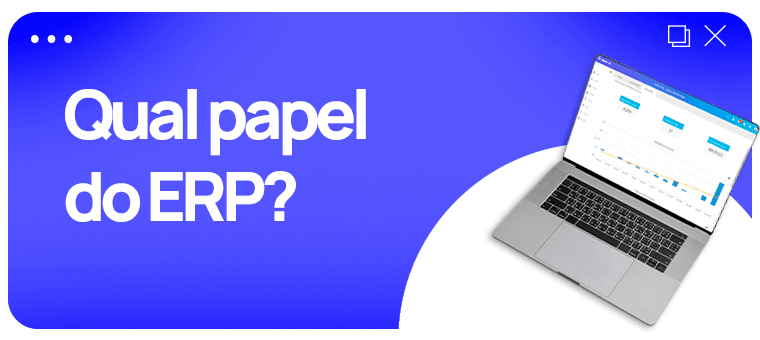
An ERP (Enterprise Resource Planning) system is a business management system that integrates all of the company's processes into a single system. As a result, cost control becomes more centralized and efficient.
This makes it easier to plan, execute, and monitor the organization's activities. The platform's advantages for cost management include the items below.
Data integration
All company data is gathered in a single system. This integration provides real-time information on production costs, sales, inventory, and other key processes.
With no need to hunt for this data across different areas or systems, analysis and decision-making become easier, since all the data is centralized and easier to access.
Process automation
The ERP automates activities such as cost calculation, financial report generation, and inventory control. This significantly reduces human error and increases the company's overall efficiency.
Processes that used to be manual and prone to failure become automatic, saving time and resources.
Performance analysis
The ERP generates detailed reports on the company's financial performance, helping with cost and profitability analysis. With this information, management can make strategic decisions to adjust processes and resources effectively, focused on better profitability.
Better inventory control
With real-time monitoring of stock levels, the company can avoid excesses that generate unnecessary storage costs, as well as product shortages that can lead to lost sales. This way, the ERP helps optimize costs related to storage and inventory management.
In addition, using an ERP results in less waste and higher profitability, since inefficient processes can be identified and corrected quickly.
Cost management is essential for any organization seeking to grow sustainably and competitively. Applying effective methodologies, using performance indicators, and adopting solutions such as an ERP are fundamental to ensuring efficient cost control without compromising the quality of products or services.
Get to know the Useall ERP and optimize your company's cost management. Request a free demo and see how we can help improve your financial results.

Originally published in Portuguese at useall.com.br.