


ERP is one of the most popular tools today, and there is a reason for that: it can provide a single ecosystem for companies to run their operations and integrate different people, departments, and data.
According to analysts, the ERP industry is expected to reach US$101.1 billion by 2025. Although that number is impressive, we have to acknowledge the following point: implementing the technology is not easy and has its challenges.
Restructuring the organizational culture for innovation, breaking internal resistance, preparing the team to use the technology, and choosing an ERP capable of meeting real business needs are the most common challenges.
In the article below we show how to overcome all these barriers, with simple tips for choosing a modern, agile, easy-to-apply tool. Happy reading!
What is an ERP?
ERP, or Enterprise Resource Planning, is nothing more than an integrated management system that brings people, departments, and data together in one place.
This means that instead of investing in different types of software for each specific department, the company can simply adopt an ERP and start running and managing all business operations in a single environment.
Why is choosing a good ERP important?
If the company wants to operate in a single ecosystem, it needs to make sure that environment will be able to meet its users' needs.
The tax department, for example, has a different routine from the purchasing department. The warehouse area does not have the same operations as the finance department.
To ensure every area of the company benefits from using the solution, leaders need to select a tool that is complete and robust. A lack of modules and features is something that can impact one or more areas at some point.
How to choose a good ERP?
Choosing a good ERP is not hard, but since there are many different software options available in the market, leaders need to stay alert and follow the tips we have prepared:

What are the company's priorities?
Every business model has a unique routine and, consequently, its own priorities. Company "x" may have bottlenecks in warehouse operations, for example, while company "y" struggles in the finance department.
The first thing to do, in this case, is to identify the company's priorities in order to know what needs to be solved and what the technology must offer to help solve it.

How many people will use the tool?
Large companies have much bigger teams than small and medium-sized businesses, so it is also important to assess the number of people who will have access to the technology and use its features regularly.
To support a high volume of access, the technology needs to be robust and capable of serving at scale. Choosing a tool that cannot do this may create future problems with usage and applicability.

Is the solution easy to use?
Much of the internal resistance is related to the difficulty of using and adapting to the solution. Users want a system that is simple, easy, and intuitive — one that actually speeds up work instead of getting in the way of the routine.
Complex systems not only cause confusion but can also frustrate employees and lead to lost productivity. Prioritize a tool that, while offering a wide range of features, does not have a complicated design and architecture.

How long does implementation take?
Migrating to new technologies takes time, often requiring the company to halt its activities for days. Nowadays, interrupting the flow of work can cause immense losses, so it is important for leaders to also assess the maximum implementation time.
The technology needs to deliver agility from the very first contact; otherwise, this may be an indicator that the solution is not as fast and capable as your company needs.

What features does the system offer?
As mentioned above, a good ERP needs to be able to meet all of the company's needs, not just deliver features that benefit one or two departments.
Modules for administrative, commercial, and corporate management; resources for production and inventory management; features for financial and accounting management; modules for service management. These are just a few examples of what the solution must include.

Is the ERP worth the price?
You also need to assess whether the investment will be worth the price, ensuring significant returns in productivity and efficiency. If the software costs too much and brings little or almost no return, the company may accumulate losses in the medium and long term — and will most likely be wasting important money that could be applied to another strategy.

Will the system keep up with the company's growth?
It is natural for the business model to evolve gradually, with the company receiving more orders and customer requests. That is why another tip that cannot be overlooked is the system's ability to keep up with this evolution and meet real needs.
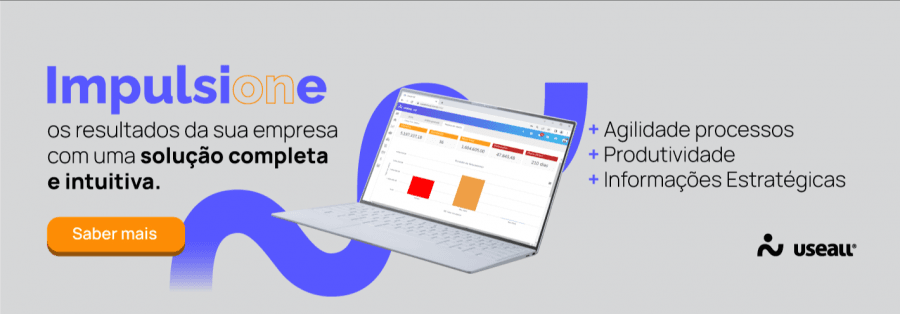
The Useall ERP was developed for industrial companies, distributors, and resellers, as well as maintenance and installation service providers, to manage all their operations. Its features include purchasing and sales management, financial management, inventory control, production control, and service management.
Companies that invest in the Useall ERP are able to reach the top, since they have access to:
- Custom dashboards and reports for tracking data in real time;
- A web system with automatic updates and backups, no installation required;
- Data centralization;
- Internal communication features such as email, calendar, online chat, document storage, discussion groups, and more;
- Custom reports;
- Humanized support online and by phone;
- ZERO backup costs.
More than a thousand clients use Useall solutions. There are more than fifty thousand users spread across Brazil. The Useall team has more than three hundred employees involved in building the tools.
Choosing the best ERP does not have to be a difficult task. Learn more about the Useall ERP and unlock the solution's full potential!
Originally published in Portuguese at useall.com.br.