


In a completely unexpected way, society realized the world was no longer the same: a virus spread across the entire globe, causing a pandemic and forcing the population to change its whole organizational structure.
Economies were shaken and companies were strongly affected by the unfolding scenario. To manage the situation, new strategies had to be adopted — one of them being remote work (home office), which allowed activities to keep moving even with employees far apart.
Having stood out in the midst of the crisis, remote work does not need to be associated with negative times. Quite the opposite: it can be seen as an opportunity and should be considered by every company!
With this transition in mind, some essential precautions need to be taken so that production performance can meet expectations. Using technology as the main ally in this task, let's understand how it can organize and automate internal processes, maintaining service excellence even at a distance.

Technology in the crisis
Technology has the potential to connect people from different places through digital means. It is a fundamental tool in anyone's life, whether for professional or personal use.
In times of crisis, such as what happened with the pandemic, technology allows professionals to continue their activities from home. However, it is the company's responsibility to provide the systems needed for internal communication to be effective — after all, the fundamental principles of information security must be upheld.
If the technology behind remote work can provide the necessary resources, internal communication is effective, and file management is secure, why not keep using this working model after the crisis?
A long-term trend?
Remote work should be treated as a trend by companies that care about their employees' well-being while, at the same time, looking for ways to reduce costs.
If these considerations make sense to you, check out the real needs of a company adapting to the remote work model and how technology can help with this transition.
Professionals need the right resources
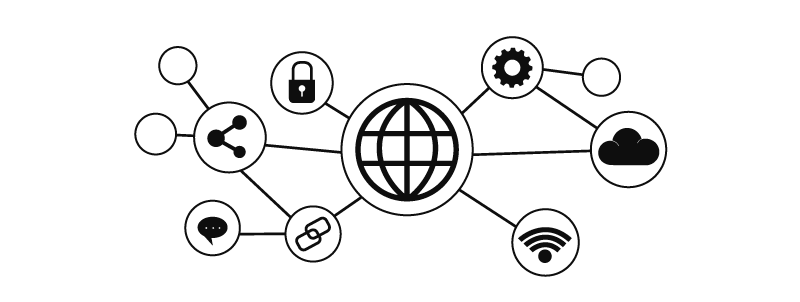
Given that the company needs to provide the right services for its employees to work from home, two precautions are essential!
One of them is managing the company's documents and files; the other is the risk management behind the systems in operation. Check out the details:
- Document and file management
Since tasks need to be performed at a distance, you need a system that ensures centralized database management, so that information from every department can be worked on.
Searches need to be optimized so that any professional querying the information database can find what they need effortlessly. It is very important that information can be accessed quickly and that the experience is friendly, with a clean, pleasant design.
It is the company's duty to ensure this system keeps information secure. After all, when working from home it will not be possible to verify how trustworthy each employee's equipment is — a single machine would be enough to infect the entire network.
The best way to guarantee these precautions is to use cloud-based management, which brings more security and practicality, since there is no internal server depending on a specialized team to administer it constantly.
- Risk management
The system needs to ensure risk management — that is, be focused on information security and increased productivity, generating in-depth analyses that guide the company's decision-making.
An integrated, easy-to-manage system allows managers to analyze the entire scope of work and make the necessary changes to keep demand balanced at all times.
Automating reports that take time to prepare ensures more strategic management, which enables greater agility in carrying out activities.
These are the minimum characteristics of a system committed to quality service. But when it comes to remote operations, the system needs to go further and meet the company's new needs.
A system prepared for remote work needs to offer the following differentiators:
- Process efficiency and speed: With resources optimized to ensure in-depth process analysis, decision-making becomes more agile and communication easier. This increases process efficiency, bringing processes up to a high standard of quality.
- Easy internal communication: With a design optimized to facilitate communication, staying in touch with your teammates is extremely practical.
- Less rework: Thanks to in-depth control of the action plan, decision-making becomes technical and based on concrete data — this avoids the need for manual processes, which often take far longer to complete.
- Fewer failures in manual processes: The digitalization of processes combined with strategic management eliminates the mistakes made in manual processes — in addition, of course, to saving resources such as paper.
- Information security: With cloud-based management as the foundation of the system's architecture, information is completely secure, free from loss and criminal attacks.
Keeping the door open to the future is a clear sign of a company's maturity — a sign that it is focused on existing innovations and wants to adapt to modern concepts of work.
Besides being visionary, it is an attitude that shows how responsible the company is, because it is the companies that look to the future that will thrive amid the new opportunities out there.
Keep up this focus: follow the Useall blog and stay up to date with information that connects you to the latest innovations in the professional market.
Originally published in Portuguese at useall.com.br.