


Disorganized, poorly executed processes can cause headaches such as production delays, wasted materials, and the delivery of low-quality items to customers.
In response, many companies are adopting BPM (Business Process Management) as an alternative to optimize internal procedures and improve results.
BPM focuses on increasing efficiency and productivity, key ingredients for a business model to succeed. In this article, we will look at what BPM is, how it works, and the main advantages it brings to organizations when it comes to process management. Enjoy the read!
What is BPM?
BPM is a discipline that unites and coordinates a set of practices applied to process management. Rather than focusing on a specific methodology, BPM is more interested in equipping the company to manage and improve its internal operations.
In this sense, the main goal of BPM is to optimize workflows, ensuring that every step is carried out efficiently — without bottlenecks, interruptions, or rework — and continuously.
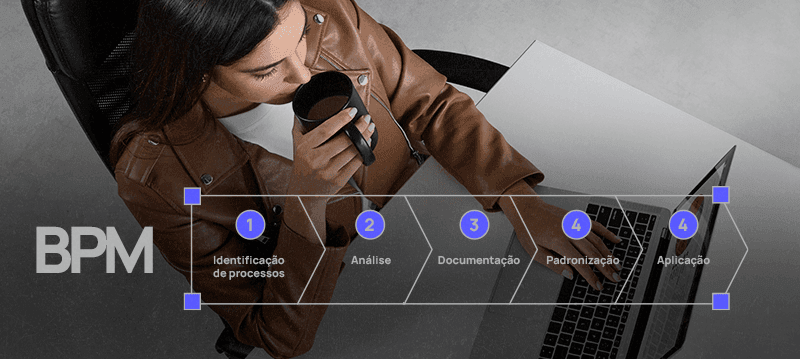
This work is divided into tasks that include:
- Process identification;
- Analysis;
- Documentation;
- Standardization;
- Applying improvements to existing operations.
Business Process Management also enables the automation of repetitive tasks, as well as the use of performance indicators (KPIs), which make it possible to monitor and identify new improvement opportunities.
BPM applies to every aspect of business management, regardless of the company's industry or size. In other words, internal operations can be aligned with each organization's strategic goals.
Advantages of implementing this methodology
Implementing BPM brings a series of advantages to the company. Let's take a look at some of them:
- Process optimization: BPM helps identify and eliminate bottlenecks, rework, and waste, enabling companies to operate with high operational efficiency and reduce costs;
- Product and service quality: with well-defined, standardized processes, businesses can deliver quality products and services to customers, resulting in higher satisfaction and loyalty;
- Adaptability: BPM also allows companies to adapt better and faster to market changes and customer demands, maintaining their market relevance;
- Customer satisfaction: a notable outcome of BPM is improved overall quality, which tends to raise customer satisfaction levels. This is crucial, because satisfied consumers tend to be more loyal to the brand and recommend it to others;
- Competitive advantage: companies that implement BPM gain a competitive edge because, by being more efficient, agile, and flexible, they become capable of outperforming the competition, reaching a higher position, and staying relevant.
Where to start? See 4 steps to implement BPM!
To obtain these (and other) benefits, it is essential to follow a specific step-by-step process to guarantee an effective BPM implementation in the project. Here are the steps:
1. Analyze the current state (AS-IS)
The first step in the BPM implementation process is analyzing the organization's current situation, which involves identifying and mapping existing processes.
It is important to understand how these procedures are structured, who is responsible for each step, and what the main challenges and obstacles are in carrying out these activities.
During this phase, it is essential to include all the employees involved so they gain a broad, accurate view of the real situation. Workshops, interviews, and reviews of documents and flowcharts can be used for this.
2. Define the desired state (TO-BE)
After analyzing the current situation, it is time to define the desired state of the processes. In this step, the company must establish the goals and objectives it wants to achieve to improve internal operations. In other words: "where do I want to get with BPM?"
During this task, identify opportunities for automation, simplification, and standardization, and define performance indicators (KPIs) to monitor progress.
Once again, it is important to involve employees, leaders, and other stakeholders to ensure everyone has a clear view of where the organization aims to go and how each person contributes to reaching the goals and objectives.
3. Redesign the processes
With the desired state defined, it is time to redesign existing processes based on everything that has already been studied. To do so, create new flowcharts and procedures that reflect the business goals.
During this procedure, it is important to take into account industry best practices — such as using management software, flowcharts, and defined KPIs — along with customer needs and operational constraints. All of this reduces the risk of a change harming existing processes.
4. Apply and monitor
After redesigning the processes, it is time to apply the changes. During this step, it is essential to invest in employee training, as well as in acquiring or upgrading systems and tools.
Once applied, the new processes must be closely monitored to ensure they are working correctly. To do so, turn to solutions that collect data and enable indicator analysis so adjustments can be made.
BPM is a powerful discipline that can bring many benefits to companies. But remember to adapt it to the specifics of your business, ensuring it is aligned with your own organization's goals.
With the right tools and a strategic approach, you can transform your processes and achieve impressive results! The Useall ERP is a technology where you can centralize, integrate, and define process flows through the Useall BPM feature.
Request a contact and learn more!
Originally published in Portuguese at useall.com.br.