



The income statement (DRE), short for Demonstração do Resultado do Exercício in Brazil, is an important accounting document that clarifies whether a company made a profit or a loss in a given reporting period.
This document presents information such as total gross operating revenue, cost of sales, and net financial expenses, among others.
When prepared correctly, the DRE can help leaders manage the business better, since these professionals come to recognize exactly what caused financial gains or losses.
Below we explain everything on the subject, from preparing the DRE to analyzing it. Check it out!
What is the DRE?
As stated above, the DRE is an accounting document that shows whether a company made a profit or a loss over a given period of time.
The DRE must be prepared together with the balance sheet, another accounting report that clarifies the company's financial position and activity.
The professionals in charge of preparing the balance sheet and the DRE are accountants (who work in the accounting field), but leaders and financial managers can review the documents and use them in business management and decision-making.
What is the DRE for?
In simple terms, the DRE serves to show, in a very visual way, what a company's net operating revenue was, and whether it managed to turn a profit after making all deductions.
For the accountant, the DRE result is information needed to compose and finalize the balance sheet. For managers, it is a report that can guide a smarter allocation of actions and resources.
How to prepare the DRE?
Preparing the DRE requires an accounting professional who will gather all the information that makes up the report. The accountant can be hired by the company through a firm or brought on as an employee.
Once hired, the professional will gather all the company's financial data for the period, organizing the information as follows:
GROSS OPERATING REVENUE (total sales made by the company. Sales may include products, goods, and services)
- DEDUCTIONS FROM GROSS REVENUE (all deductions applied to sales: canceled sales, returns, discounts, and taxes)
(-) Canceled sales or sales returns (-) Unconditional discounts (-) Rebates (-) ICMS, PIS, and COFINS
= NET OPERATING REVENUE (amount obtained after making the deductions from gross revenue)
- COST OF SALES (the sum of everything the company spent to produce, purchase, and store products until their sale: cost of products sold, cost of goods, cost of services rendered)
= GROSS OPERATING PROFIT (the amount the company earned before deducting operating expenses)
- OPERATING EXPENSES (all the expenses the company incurred to keep running: selling, general and administrative, and financial expenses)
(-) Selling expenses (-) General and administrative expenses (-) Financial expenses
- FINANCIAL REVENUE (what the company earned from investments and financial market holdings)
= OPERATING PROFIT OR LOSS
+ NON-OPERATING REVENUE (from transactions outside the company's core activities, such as the sale of a vehicle used to transport goods)
- NON-OPERATING EXPENSES (amounts not tied to business operations, such as bank fees and loan interest)
= RESULT FOR THE PERIOD BEFORE THE PROVISION FOR CORPORATE INCOME TAX (IRPJ) AND SOCIAL CONTRIBUTION
- PROVISION FOR INCOME TAX (an estimate of how much corporate income tax the company will have to pay to Brazil's Federal Revenue Service)
- PROVISION FOR SOCIAL CONTRIBUTION (the estimated amount the company will pay for this tax)
= RESULT FOR THE PERIOD AFTER THE PROVISION FOR IRPJ AND SOCIAL CONTRIBUTION
- PROFIT SHARING (the amount received by a company partner in the event of a positive result)
- DEBENTURES (debt securities issued to fund projects; they can only be issued if the company is publicly traded on the stock exchange)
- MANAGEMENT AND BENEFICIARY PARTIES (negotiable instruments granting managers and shareholders a share in the company's annual profits).
READ ALSO | Direct and indirect manufacturing costs: do you know how to control them?
DRE: how to analyze the information?
Once the DRE structure is complete, the manager, accountant, or business owner can analyze the information to identify possible operational bottlenecks or spot opportunities to increase profits.
The main approaches are vertical analysis and horizontal analysis.
Vertical analysis
It involves calculating the percentage of each DRE line item to identify the impact each one has on business operations.
To find the percentage, the professional should apply the following formula:
VA = (line item under analysis / gross revenue) x 100
For example, say the line item under analysis is administrative expenses, and that these costs totaled R$ 60,000.00 (sixty thousand reais) in the period. Considering the company's gross revenue was R$ 2,000,000.00 (two million reais) for the year, the percentage would be:
VA = (60,000 / 2,000,000) x 100
VA = 3%
By finding the percentage of each line item that makes up the DRE, you can identify where the company is spending the most or generating the most revenue — and, from there, take steps that help cut expenses or boost earnings.
Horizontal analysis
Horizontal analysis consists of comparing line items over the years. In other words, you compare the value of a DRE line item with the same item from the previous period.
This comparison lets the professional track the evolution of revenue and expenses, showing where the company got it right or wrong in the period.
To find the variation from one year to the next, the professional can also apply the formula below to arrive at the percentage.
HA = (value in the base period / value in the comparison period) – 1 x 100
Using the same example above, say the administrative expenses line item was 52,000.00 in 2022.
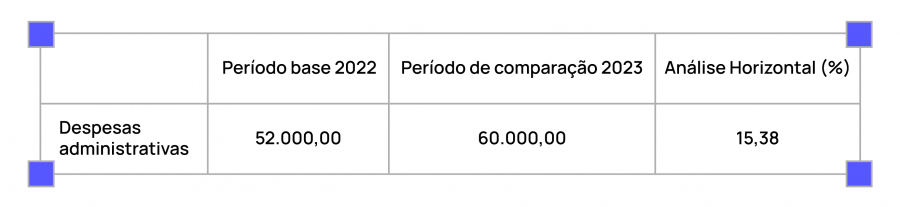
In this case, the item varied by:
HA = (60,000 / 52,000) – 1 x 100
HA = (1.1538) – 1 x 100
HA = 0.1538 x 100
HA = 15.38%
READ ALSO | Financial planning: 4 tips on how to build one
6 advantages of preparing and analyzing the DRE

Going beyond an accounting report, the DRE is a tool that, when applied to business management, can help business leaders achieve a series of benefits. They are:

Greater financial clarity
The DRE offers a detailed, organized view of revenue, costs, and expenses. From the analysis, it is possible to determine whether the company is generating profit or loss, and to make better-informed decisions to keep finances on track or expand the business.

Long-term performance evaluation
Comparing DREs from different periods can help professionals identify trends and patterns. The information can show, for example, whether the company is growing steadily, facing seasonality, or even going through financial fluctuations.

Strategic cost control
The DRE clearly identifies which areas of the company are consuming most of the financial resources. This makes it possible to implement preventive actions to control or reduce costs in specific areas.
For example, if the income statement shows that marketing costs are rising, strategies can be reviewed to optimize that spending.

Better communication with investors and creditors
If the company is seeking financing or partnerships, the DRE is a tool that can make closing deals easier. Investors and creditors can analyze the report to assess the company's financial health, as well as evaluate its potential return or risk.

Tax planning
With the DRE, you can also calculate taxable profit and structure a plan to minimize the tax burden. With this tax intelligence, the company can take advantage of available deductions and incentives without running afoul of tax regulations.

Tracking goals and objectives
Using the DRE, the company can also evaluate whether business operations are really moving in the right direction. If the answer is no, it can act proactively to make adjustments and increase sales, for example, or reduce costs.
Want to improve your plant's results? Learn how to apply high-performance management!
The role of technology in issuing and analyzing the DRE
The DRE is, without a doubt, an important tool for managing the business. But just as it can be applied to cut costs and increase financial returns, it can also have negative impacts if the figures are entered improperly.
If, while filling out the report, the professional gets the information wrong or omits an important piece of data, the company may arrive at an incorrect profit-and-loss result — and, based on that, take actions that could hurt its financial situation even more.
That is why it is important to stress how much the company needs good technology. These solutions are what will guarantee the reliability of the DRE and other reports, from the moment of issuance through analysis.
Useall offers an ERP that, in addition to centralizing every business process and operation, delivers features and functionality for the company to safeguard its financial health. Simplify management with a complete ERP. Issue your company income statement with data from the Useall ERP!

Originally published in Portuguese at useall.com.br.