


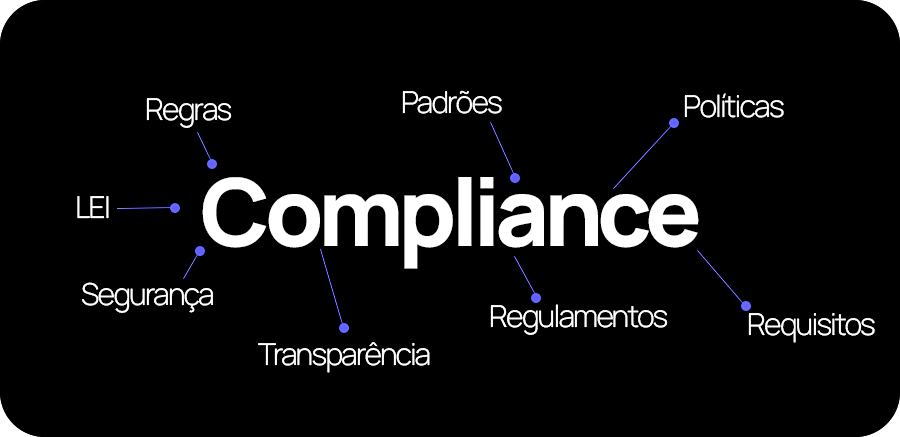
Compliance is not just about laws – it is about trust. Is your company prepared to prove that it follows the rules and can scale safely?
In the corporate world, the term compliance is associated with conformity to laws and regulations. However, it goes far beyond that: it is a set of ethical practices and behaviors aimed at ensuring honest, transparent, and responsible operations within companies.
A report by ACI Institute Brazil in partnership with KPMG's Board Leadership Center Brazil shows that 90% of companies in Brazil already had audit committees by the end of 2024. Beyond staying up to date with internal and external standards, ensuring compliance in the business helps create a safe and transparent environment for customers and employees.
Today, we explain everything leaders and managers need to know to ensure compliance.
What is compliance?
Simply put, compliance is the practice of following the rules, regulations, laws, and standards that govern the proper functioning and efficiency of a company. The word means conformity or adherence.
However, the term can be defined more broadly, including ethics and transparency practices that go beyond legal requirements. Compliance fosters an organizational culture that promotes correct, transparent behavior and adds value to the brand's reputation. It even includes clear anti-corruption policies, fair competition practices, and social and environmental responsibility.
Why is compliance increasingly important for companies in Brazil?
With the growing complexity of regulations and the constant evolution of laws in Brazil — such as the General Data Protection Law (LGPD), the Anti-Corruption Law, and labor legislation — compliance has become a fundamental pillar of good governance for any organization.
Brazil has a dense regulatory system and a complex reputation when it comes to corruption, with elevated risks for many companies. Failing to adopt compliance practices can result in serious damage to the business's image and financial health.
Among the consequences, the company may face:
Heavy fines;
Lawsuits;
Loss of contracts;
Even going out of business.
And the risks are not only legal, but also reputational. The trust of customers, partners, and investors can be hard to rebuild once damaged.
What non-compliance situations are common in manufacturing and distribution?
In companies' day-to-day operations, several situations can constitute non-compliance with established regulations or standards. Some are more visible, such as failure to pay taxes or non-compliance with environmental standards. Others may go unnoticed but are equally harmful, such as unfair competition practices and failure to uphold labor rights.
In manufacturing and the distribution sector, it is common to find a lack of adequate controls over production, delivery, and product tracking processes. If processes are not well monitored, for example, quality control failures can occur, leading to defective or even harmful products.
In addition, a lack of transparency in relationships with suppliers or customers can result in fraudulent practices and in financial and reputational losses.
What is the relationship between compliance and corporate governance?
Corporate governance is a set of practices and principles aimed at ensuring the sound management of a company. Compliance is part of the package, as it helps ensure those practices are actually followed.
Companies with good compliance practices can ensure that all processes conform to applicable standards, from production to customer service. This, in turn, improves the confidence of directors and other stakeholders in the operation and strengthens the organization's image in the market.
How does technology support compliance?
Technology plays a very important role in consolidating compliance practices. ERP systems and management solutions, for example, enable data centralization, ensuring that all areas of the company operate in an integrated manner and in conformity with standards.
In process control, automation can help standardize operations and reduce human error, ensuring that each stage of the cycle follows clear compliance guidelines. This, in turn, increases efficiency and minimizes operational risks.
Traceability and the ability to conduct audits are also strengthened with technological support. Every action or movement can be recorded and monitored by leaders and managers, contributing to the identification of errors and the swift correction of deviations. Consequently, this also increases transparency and reinforces trust in the company's governance.
And how do technology and compliance generate more transparency, market trust, and competitiveness?
The transparency generated by process automation and data traceability shows the market that the company is truly committed to compliance and ethics.
As for market trust, it expands and solidifies because, by demonstrating conformity with regulations and best practices, the company creates a safer environment for customers, partners, and investors.
Regarding competitiveness, many customers look for transparent, responsible, and safe organizations to do business with. Therefore, technology combined with compliance can help the company open doors to new partnerships, contracts, and business opportunities.
Is compliance a cost or an investment?
Although implementing such a program involves initial costs, such as adapting operations to standards and training employees, the long-term benefits outweigh the investments.
That is because, by investing in compliance, the company protects itself against legal, financial, and reputational risks that could eventually generate far higher and more significant costs.
How can Useall help with compliance in your company?
If your company has not yet invested in compliance, Useall now offers a new opportunity for your structure. It is our digital ombudsman channel, a tool designed to ensure transparency and adherence to compliance standards.
The platform allows employees, customers, and suppliers to file complaints, reports, or suggestions confidentially and securely, promoting an environment of open and responsible communication.
Check out our ombudsman channel right now!

Originally published in Portuguese at useall.com.br.