



Customer satisfaction is directly related to a company's success, especially for businesses focused on services, since in this case the consumer's experience is what counts most for their credibility.
Along these lines, a study by Adyen/KPMG showed that 70% of Brazilian consumers do not buy from a service company again after a bad or unsatisfactory experience. Paying attention to this issue is therefore fundamental to a business's success.
With that in mind, we have prepared an article with the key information about customer satisfaction in the service industry and how to calculate this score in your company. Keep reading!
What is customer satisfaction?
Customer satisfaction refers to how consumers feel about the experience they had with a product, service, or brand. A positive buying experience therefore means a satisfied customer whose expectations were met or exceeded. This applies both to B2B clients (business/business) and B2C (business/end consumer).
Thus, the greater the gap between what the customer expected and what they found in the service, the lower their satisfaction. On the other hand, the closer the experience comes to meeting or exceeding their expectations, the better it will be.
That is why it is essential to measure the customer satisfaction score for the services offered by your company. This information can indicate what is working well and what needs to improve.
Factors that influence customer satisfaction
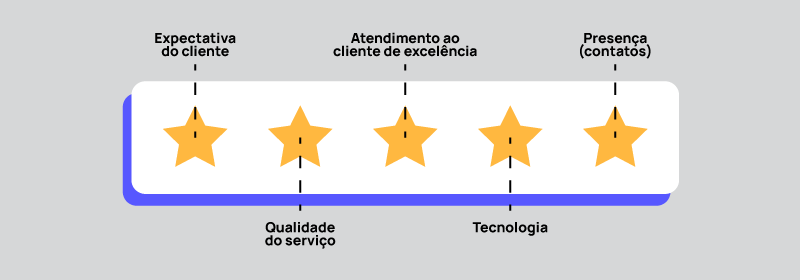
Some factors can directly influence consumer satisfaction, and monitoring them is fundamental to your company's success. Here are the main ones:
Customer expectations
The first factor is the customer's expectations: when they hire a service, they expect it to solve their problem. An efficient way to identify customer expectations is to conduct market research.
Market studies provide information that lets managers understand their customers' pain points and, based on that, define strategies to make their service attractive and effective.
Service quality
The main pillar of customer satisfaction is the quality of the service offered. No matter how much your company invests in a good marketing campaign and trains its sales team, if the service offered lacks quality, the consumer will have a negative experience.
Therefore, quality must be the primary focus for achieving customer satisfaction and increasing sales in your organization.
Excellent customer service
Another factor is the service the company provides. This means that even if the service itself is high quality, if the customer is not served efficiently, their expectations may not be met.
That is why it is important to invest in training your team, so it delivers high-quality, humanized, effective customer service.
Presence (contact channels)
Presence is a factor that refers to the contact channels the company makes available to consumers so they can resolve questions, give praise, or file complaints.
Ideally, the organization should invest in more than one contact channel, since that allows it to serve its different audiences — for example, phone, email, social media profiles, website, and so on.
Today, investing in digital presence is a market trend, and a company that pays attention to this can undoubtedly stand out and grow quickly.
Technology
Technology stands out as an essential solution for offering quality services and achieving customer satisfaction.
Innovations such as software, for example, streamline the customer service process, since your employees can use them to quickly resolve consumers' questions, ensuring their problems get solved.
The Customer Satisfaction Score indicator

One of the best ways to measure customer satisfaction in the service sector is through the Customer Satisfaction Score (CSAT). It is a short questionnaire designed to evaluate the customer's experience right after their interaction with a brand.
CSAT usually consists of a single question in which customers rate the service provided immediately after the interaction. The question may vary, but the logic is always the same: the higher the score or rating, the higher the satisfaction.
Here are some examples of questionnaires using this methodology:
Numeric scale (0 to 10, for example);
Unsatisfied, satisfied, and very satisfied;
Terrible, bad, fair, good, and excellent;
Number of stars for the experience.
How to measure the Customer Satisfaction Score?
The answers collected through the CSAT questionnaire are used to create a customer satisfaction score for the service.
To reach this score, take the number of satisfied customers and divide it by the number of consumers who answered the questionnaire. Then multiply the result by 100.
Shall we look at an example? Suppose that:
- 200 people answered the satisfaction survey;
- Of that total, 150 gave the service they received 5 stars. The rest (50), however, gave other star ratings.
Based on this data, we arrive at the following result: 150 ÷ 200 x 100 = 75
In this example, 75% of customers are fully satisfied with the service they received.
See how important it is to measure customer satisfaction with the services your company offers? It is a way to make sure your business evolves and is able to exceed your audience's expectations. The good news is that the CSAT indicator can streamline this process.
Make your company more efficient with the Useall system! It is the perfect solution for anyone who wants to optimize service management and guarantee quality.
Originally published in Portuguese at useall.com.br.