


What is 5S?
The 5S Program is a work philosophy that seeks to promote discipline in the organization through everyone's awareness and responsibility, making the workplace pleasant, safe, and productive.
The tool known as the 5S Program emerged around 1950, shortly after World War II, out of the need to fight the dirt in factories and the structural disorganization Japan was suffering from.
I want to receive news about Quality Management
In May 1991, the program was formally launched in Brazil, aiming to create a suitable environment for implementing Total Quality Control (TQC).
Some goals of the Program
- Improve people's quality of life by promoting a healthy and welcoming work environment.
- Promote teamwork to improve relationships among people;
- Build a workplace of clear happiness, so that it is attractive to everyone who works in it;
- Improve productivity and promote waste reduction in the organizational environment.
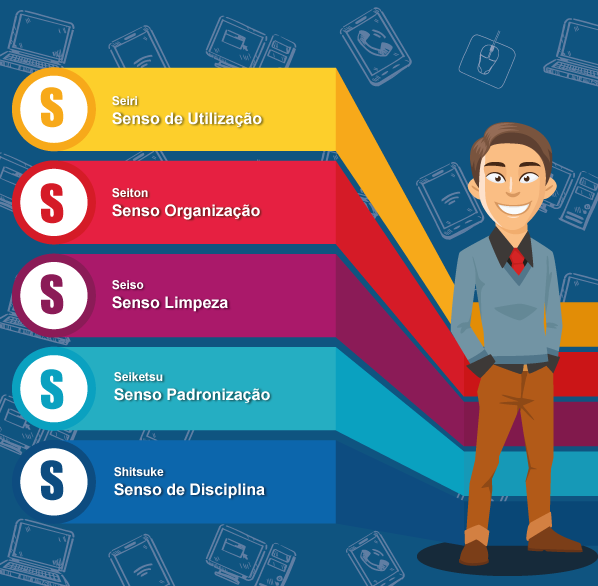
The 5 senses
The idea of a "sense" best reflects deep behavioral change, indicating that one must "feel" the need to act.
Currently, traditional 5S implementation models only address the methodology, step by step, without anticipating the natural difficulties that will be encountered at the various stages. Knowing these difficulties in advance allows the organization to make a more realistic plan that accounts for the unexpected.
Below, we detail some essential steps for a successful implementation of the program.
1. Getting strategic people on board
In large and mid-sized organizations, it is not common for the initiative to implement 5S to come from top management. The idea usually comes from an employee at the management level or from certain processes in the organization (Human Resources, Quality Management, Industrial Safety, Production, etc.). However, even if the initiative does not come from top management, winning over senior leadership — as well as the organization's other strategic people — is fundamental for a systematic 5S implementation, before any action aimed at extending 5S to the entire organization. As a general rule, 5S should not be implemented at one level of the organization if the level immediately above has no knowledge of the subject.
2. Forming the 5S committee
Once top management has made the decision to implement the program and chosen the manager who will coordinate it, the 5S Committee is formed.
The Committee's basic activities are:
- Drawing up the implementation plan
- Following up on the actions set out in the plan
- Answering for 5S before top management
- Coordinating the assessments and analyzing the results
- Planning for and securing resources to promote 5S
- Taking part in internal and external events related to the topic
- Hiring and overseeing external consultants (when necessary).
3. Training
To promote 5S training at all levels, some preparation activities must be carried out:
Define the program's name
It is very important to create a name that matches the organization's culture — a name that serves as a reference whenever the program is mentioned. Employees' creativity can help a lot in choosing the program's name.
Define the implementation strategy for each "S"
Work first on promoting the first three "S"s (Seiri, Seiton, and Seiso), and only after they have been effectively accepted and implemented — producing the expected results — move on to implementing the other two "S"s, SEIKETSU (sense of health) and SHITSUKE (sense of self-discipline). This can increase the success of the implementation and the continuity of the program.
Map the areas
Mapping the work areas serves several purposes:
- Creating greater commitment from leaders, since 5S results can be broken down by area;
- Sizing the training of facilitators/multipliers and auditors;
- Making it easier to implement a recognition system.
There is no uniform criterion for this mapping. The recommendation is to do it, as far as possible, according to the organization's own hierarchy — that is, each mapped area has a person in charge who, within the org chart, officially answers for that area.
Define the training system and the educational and promotional materials
The Committee must define how the training sessions will be conducted, as well as prepare or review the appropriate materials for each audience (leaders, multipliers, employees, auditors). When hiring instructors or purchasing external materials (handouts, films, books, booklets, posters, banners, streamers, etc.), check whether the names used for the process and the meaning of each "S" are consistent with what the organization has defined.
Define the Assessment Criteria
The committee must define the 5S assessment criteria (especially for the first three "S"s) before conducting the training sessions, so they can be presented during training, even if only briefly.
4. Preparing for the 5S Launch
The famous "D-Day"!
This event is fundamentally important for kicking off the 5S implementation, for the following reasons:
a) It serves as the "milestone" of 5S implementation in an organization;
b) It motivates work teams to definitively implement 5S;
c) It promotes an organized group effort;
d) It visually demonstrates the improvements 5S brings to the workplace.
Since this is an event that may mobilize the entire organization, a dedicated team can be formed to plan and coordinate it, including people who are not necessarily part of the 5S Committee. An important tip: don't forget to take before-and-after photos of D-Day — this comparison shows just how much the areas involved benefited from the program.
5. Audit Planning
The organization must plan how the audits will be carried out. The first step is to delimit the areas and their respective owners. The second step is to define the criteria to be audited, which should be based on the senses and the particularities of the area being audited.
6. Publishing target results
Organizational communication must be effective so that the information reaches everyone and the current results obtained through the audits are easy to understand, identifying what can be improved and applying actions to reach the established targets.
7. Recognition system
It is essential that the recognition system be part of the organization's culture. To that end, consult human resources professionals, strategic planning, or other support departments that handle the corporation's professional development, in order to avoid clashes and reconcile the recognition system with something that already exists.
Maintaining the 5S Program
To keep the program going, involve professionals by delegating responsibilities, and maintain constant assessments across the company's areas so the program is not forgotten. Communicate the progress achieved — this provides greater visibility and makes an excellent impression of the program on employees.
Here you have seen an overview of 5S plus a way to apply it. Share with us your experience with this program, or how the implementation and adoption of 5S went at your company.
We'll see you in the comments!
Originally published in Portuguese at useall.com.br.