



Industrial labor outsourcing is a widely adopted strategy to improve processes and reduce costs. By delegating activities to specialized suppliers, companies gain efficiency and can focus on strategic areas.
However, outsourcing also presents challenges, such as the need for strict quality control, contract management, and compliance with labor and regulatory standards.
In this article, we cover the main aspects of industrial outsourcing, from its benefits, types, and challenges to the criteria for choosing partners. We also address its impact on quality management and the legal aspects surrounding outsourcing contracts.
Keep reading!
What is industrial outsourcing?
Industrial outsourcing consists of delegating specific activities to external suppliers. The company hires specialized services without needing to develop certain production capabilities internally.
This practice is widely used in sectors such as automotive, metallurgy, pharmaceuticals, and electronics. Outsourcing allows companies to be more agile and flexible, responding quickly to market changes without having to significantly expand their internal structure.
In addition, this business model reduces the need for heavy investment in new technologies and infrastructure. After all, outsourced suppliers already have the expertise and modern equipment to perform the delegated activities.
What are the benefits of industrial outsourcing?
With industrial outsourcing, companies gain a series of advantages that lead to better results. They get more time to focus efforts on innovation, new products, and improving the customer experience.
Check out the main benefits!
Lower operating costs
By hiring external services, the company reduces operating costs on infrastructure, specialized labor, and equipment. Fixed costs are converted into variable ones, which creates greater financial flexibility, allows more efficient resource allocation, and improves business profitability.
In addition, outsourced suppliers usually operate at scale. This delivers services at a more competitive cost than a company could achieve internally.
Focus on the core business
With outsourcing, the company can focus on its core business. Internal activities can be redirected to more strategic areas of the business, such as research and development.
By delegating secondary activities to specialists, the company can concentrate its efforts on innovation and on improving products and services. This strengthens market competitiveness and allows the company to stand out from the competition.
Access to technology and specialized expertise
Another important benefit is access to advanced technology and specialized knowledge. Outsourced suppliers frequently invest in state-of-the-art equipment and continuous training for their teams.
As a result, the contracting company can maintain high production standards without having to bear the high costs of technology upgrades.
How do the types of industrial outsourcing work?
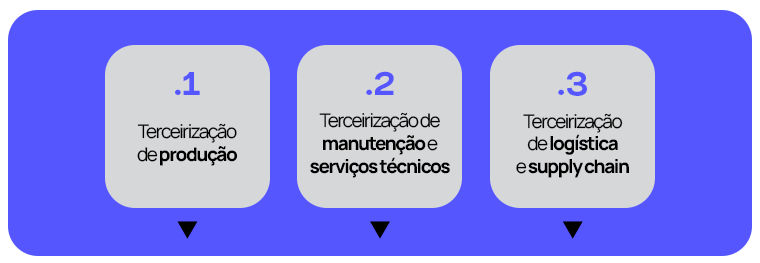
The choice of the type of industrial outsourcing depends on the organization's strategic needs, the level of specialization required, and the pursuit of operational efficiency. Check out the main models below.
Production outsourcing
One of the most common models is production outsourcing, where part of the manufacturing process is handed over to external suppliers. This is common in the fashion, electronics, and automotive industries, as it creates greater flexibility and efficiency in the production chain.
In addition, production outsourcing can be useful in times of high demand, to handle order peaks without permanently expanding production capacity.
Maintenance and technical services outsourcing
This model is common in industries that use heavy machinery, where specialized maintenance is essential to prevent failures and ensure productivity.
Beyond corrective and preventive maintenance, outsourced suppliers can offer 24-hour technical support. This reduces equipment downtime, minimizes impacts on production, improves operational reliability, and extends the useful life of industrial assets.
Logistics and supply chain outsourcing
Logistics and supply chain outsourcing involves transportation, warehousing, and distribution services. It can also include services such as cargo tracking, route planning, and inventory management. It is essential in sectors like retail, where short delivery times are a competitive advantage.
Specialized logistics companies optimize processes and shorten delivery times, making the supply chain more agile and efficient. They also help reduce waste, improve customer satisfaction, and enable a faster response to changes in demand.

What are the challenges and risks of industrial outsourcing?
Outsourcing in manufacturing brings many advantages, but it also presents challenges and risks that need to be managed to ensure an efficient operation aligned with the company's strategic goals. Check them out!
Excessive dependence on third parties
Excessive dependence on third parties can compromise operational continuity if a supplier faces financial or production problems. To minimize this risk, companies should diversify their supplier base and establish contingency plans.
Another concern is the loss of control over critical processes. A lack of oversight can result in quality failures and production delays, which negatively impact the company's reputation.
Quality control and standardization
Outsourced companies need to follow the quality standards required by the contracting company, to avoid failures that could harm the reputation and reliability of the products.
In addition, standardizing processes between the contracting company and its suppliers prevents inconsistencies and ensures that products meet the desired specifications.
It is therefore essential to establish periodic audit and inspection processes. The use of integrated management systems can facilitate this communication and ensure more efficient monitoring.
Labor issues and legal compliance
Labor legislation imposes obligations and risks that must be managed carefully in contracts. Non-compliance can result in labor liabilities and fines.
In addition, outsourcing must comply with regulatory standards, such as NR-12 for machinery and equipment safety and the rules of the CLT labor code. The contracting company must ensure its suppliers follow these guidelines to avoid future legal problems.
Information security and intellectual property
Sharing data with third parties requires measures to prevent leaks and protect intangible assets. Confidentiality clauses and monitoring are essential to minimize risks.
Companies that outsource strategic areas, such as product development and technology, must invest in cybersecurity protocols and strict contracts to prevent leaks of sensitive information, especially after the arrival of Brazil's General Data Protection Law (LGPD).
What are the criteria for choosing an outsourcing partner?
Choosing a partner for outsourcing in manufacturing requires careful analysis to ensure quality, efficiency, and compliance with market requirements. Here are the main criteria to evaluate!
Certifications and industry experience
Partners with certifications demonstrate a commitment to quality and efficient process management. In addition, experience in similar projects is an indicator of the ability to meet expectations. Reviewing portfolios and success stories can provide valuable insights into a supplier's competence.
Production capacity and operational flexibility
The partner's production capacity must be compatible with the company's needs, especially in terms of volume and delivery times. Operational flexibility also allows the partner to adapt to changes in demand or unforeseen events during project execution.
Track record of compliance with technical standards
Compliance with the sector's technical standards and regulations reflects good safety, quality, and sustainability practices. This track record can be verified through references, audits, or checks with regulatory bodies. The presence of integrated management systems also ensures process traceability and compliance.
Innovation capacity and use of technology
Companies that invest in research and development, automation, and digital solutions tend to offer more efficient services aligned with market trends. Adopting technologies such as the Internet of Things (IoT), artificial intelligence, and data analytics can bring significant competitive advantages.
Market reputation and references
Seeking references from other companies that have already worked with the supplier can provide insights into their reliability, service quality, and ethical conduct. Feedback and testimonials from previous clients help identify potential problems or points of attention before closing the partnership.
Organizational culture and value alignment
Companies with aligned values and visions tend to communicate more efficiently and maintain a more harmonious relationship. This makes conflict resolution and joint decision-making easier.
Costs and the partner's financial structure
A supplier with financial problems can jeopardize service continuity or delivery quality. Analyzing financial statements and understanding the partner's cost structure helps ensure they are able to honor their commitments.
How does industrial outsourcing impact quality management?

Industrial outsourcing has a significant impact on quality management, requiring strict controls to ensure that products and services meet the standards demanded by the market. Here's what to know.
Implementing control and audit processes
Outsourcing requires implementing robust control and audit processes to ensure quality standards are maintained. This includes defining clear metrics, conducting regular inspections, and analyzing performance indicators.
Quality management should be a shared responsibility between the contracting company and the outsourced partner. Creating checklists and verification protocols can help standardize processes and ensure delivery consistency.
Alignment with ISO certifications and good industrial practices
Adopting ISO certifications, such as ISO 9001 (quality management), is a recommended practice for companies that outsource processes. These certifications ensure that processes are standardized and aligned with the sector's best practices.
In addition, alignment with international standards makes integration with global partners easier. Implementing a quality management system (QMS) can be a differentiator for ensuring compliance and continuous improvement.
Monitoring performance indicators (KPIs)
Monitoring KPIs is essential to evaluate the performance of outsourced processes. Indicators such as delivery time, defect rate, and cost per unit produced provide valuable insights into the efficiency and quality of the services provided.
Analyzing this data enables the identification of improvement opportunities and strategic decision-making. Business Intelligence (BI) tools help visualize and analyze these indicators more efficiently.
What should you know about legal and contractual aspects?
Industrial outsourcing involves a series of legal and contractual aspects that help ensure legal certainty and avoid labor, tax, and operational risks. We've listed the main items to check.
Service level agreements (SLAs)
SLA agreements define the service levels expected from the outsourced partner, including deadlines, quality standards, and performance metrics. These agreements are fundamental to ensure the contracting company's expectations are met and to establish penalties for non-compliance, preventing misunderstandings and future conflicts.
Tax and labor responsibilities
The contracting company must ensure the partner complies with tax and social security obligations to avoid legal liabilities. It is also important to clearly define each party's responsibilities regarding outsourced employees, ensuring compliance with labor and tax laws.
Contract management and confidentiality clauses
Contracts should be detailed and include confidentiality clauses to protect the contracting company's sensitive information. It is also advisable to review them periodically to ensure they remain aligned with business needs. Including termination clauses and penalties for non-compliance is another important part of contract management to protect the company's interests.
Data protection and information security
With the growing digitalization of industrial processes, data protection and information security have become critical aspects of industrial outsourcing. Contracts must include specific clauses on data protection, especially in compliance with regulations such as the General Data Protection Law (LGPD) in Brazil or the General Data Protection Regulation (GDPR) in Europe. Implementing cybersecurity measures should also be a priority.
Discover the Useall ERP for your outsourcing process!
Outsourcing in manufacturing can be a powerful strategy to reduce costs, increase efficiency, and focus on the core business. However, its implementation requires planning, choosing the right partners, and careful process management.
Useall's mission is to bring technology to companies to make business growth easier through the full integration of every area. Our management system enables precise control of all industrial operations, including outsourcing control, ensuring greater productivity, lower costs, and compliance with regulatory standards.
Discover how we can help your company reach new levels of operational excellence with efficiency, compliance, and focus on what really matters to your business. Get to know the Useall ERP and gain full control over your outsourcing process!

Originally published in Portuguese at useall.com.br.