


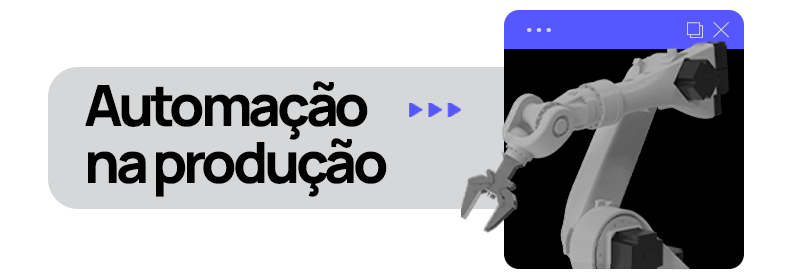
Every company that wants to increase factory quality and productivity needs to invest in production automation. Here's why!
We are living in the era of digital transformation, and automation is one of the basic prerequisites for any company that wants to keep up with innovation and stay competitive.
Many businesses have already understood the role and importance of automating their processes, with 78% already investing in automation in 2023, according to the study "OTRS Spotlight: IT Service Management 2023". Still, some remain skeptical about how effective automation really is.
Today we will try to break down that view, showing how automation can be used to increase quality and productivity in production while also reducing human error and operating costs.
Read on!
But first, let's recap what automation is
Automation is a term that refers to replacing manual activities with automated processes. In other words, it requires implementing programmable technologies capable of performing tasks with minimal human assistance.
Up until twenty years ago, it was common to see manufacturers and distributors — companies with a large volume of processes — running their operations manually. Today, however, the scenario is different.
The arrival of robots, artificial intelligence, software, and other technological solutions has allowed many stages within industries and distributors to be carried out with greater "independence" by systems and machines.
In this context, production automation is...
If automation is the ability to perform tasks with minimal human assistance, it follows that production automation is simply the mechanization of some or all of the stages that make up the production process.
These stages can range from assembly to:
- Inspection;
- Packaging;
- Transportation;
- Quality control;
- And more.

Why automate production?
Production automation is recommended because it helps the company maintain or increase its production capacity without needing to hire additional labor.
That means it doesn't matter if order volume was low one month and jumped 100% the next. The company will be able to run its operations and meet the delivery deadline promised to the customer.
But increasing the capacity to meet demand more flexibly is not the only reason automation is recommended. Why do we say that? Because by automating processes, a company can benefit in several other ways.
- Product and service quality improves, since machine precision is greater than human precision.
- Shop floor productivity increases, as processes become continuous and free of interruptions.
- Operating costs can be reduced, since waste is avoided and there is less rework.
- There is practically no room left for errors, because automated systems follow strict, configurable standards.
READ ALSO | How to choose the best ERP for your company
What are the types of production automation?

Very good! We have seen that production automation brings many advantages, but what is the step-by-step process for implementing it?
Before we answer that, it is important to review the existing types of automation, because that understanding is what will allow you to choose the best system or technology to automate your processes.

Fixed automation
Fixed automation, as the name suggests, is the kind that remains unchanged. In other words, it is configured to perform a single procedure, and that's it. This model is highly recommended for large-scale production, precisely because it minimizes variation and generates more efficiency in repetitive tasks.

Flexible automation
Flexible automation, on the other hand, is a type that allows adjustments and reconfigurations. With it, we can adapt the equipment as our company's goals change. The manufacturers that typically apply this type of automation are those dealing with seasonal demand or production peaks.

Programmable automation
Programmable automation, in turn, is the kind in which tools, machines, and systems can be programmed to perform a specific sequence of tasks. Manufacturers with a large number of processes can do well with this type of automation, since the configuration can be set or reprogrammed batch by batch.
I've decided I want to automate — now what?
Once a business owner or manager understands the benefits of automation and decides to invest in the technology, it's natural to ask: "What do I need to do to automate my production line?"
The experts here at Useall recommend the following:
Start by assessing the current production process to identify which stages are repetitive and can be automated;
Establish the goals of production automation, so the team has a clear direction and knows exactly what the company expects to achieve;
Analyze the budget situation to make sure that investments in automated tools and systems will not harm the company's cash flow in any way;
Research the technologies available on the market that can contribute to process automation, validating compatibility with other systems and the benefits;
Run tests with the chosen solutions to make sure they truly deliver what they promise;
Build a technology implementation plan to guide activities and prevent failures during the transition;
Don't forget to train the team — although machines, equipment, and systems will be responsible for executing the tasks, it is the employees who will configure the technologies and ensure they perform the procedures correctly.
What should you consider when choosing automated machines, equipment, and systems?

There are many tools a business owner or manager may come across while researching. So what needs to be taken into account to acquire the right technologies for their needs?
- Ability to integrate with the systems already in use at the company;
- Cost-effectiveness;
- Supplier reputation;
- Support;
- The solution's potential for scale and flexibility to keep up with demand in any scenario.
Major brands such as Toyota, Siemens, Tesla, Nestlé, and Amazon have already adopted production automation successfully, and today they reap benefits such as greater logistics efficiency, shorter order processing times, better use of warehouse space, and fewer human errors, among others.
To walk side by side with these giants and reap these and other advantages of automation, all you need to do is take your first step. Get to know the Useall ERP and see how our technology can help you automate your production processes.

Originally published in Portuguese at useall.com.br.